
Exams can feel stressful, especially when you have multiple subjects to prepare in a short time. Many students study hard but still struggle because they don’t manage their time properly. Good time management during exams helps you cover the syllabus, reduce anxiety, and perform better in papers.
This guide will share practical, student-friendly time management tips for exams, step-by-step strategies, and mistakes to avoid so you can stay organized and confident.
Why Time Management Is Important During Exams
Managing your time effectively is not just about studying longer hours — it’s about studying smarter.
Benefits include:
- Completing syllabus before exams
- Better revision and practice
- Reduced exam stress and anxiety
- Improved concentration and memory
- Higher marks in board exams
Pakistani board students preparing under boards like the Board of Intermediate and Secondary Education Rawalpindi often face tight schedules, so planning becomes even more important.
Smart Time Management Tips for Students During Exams
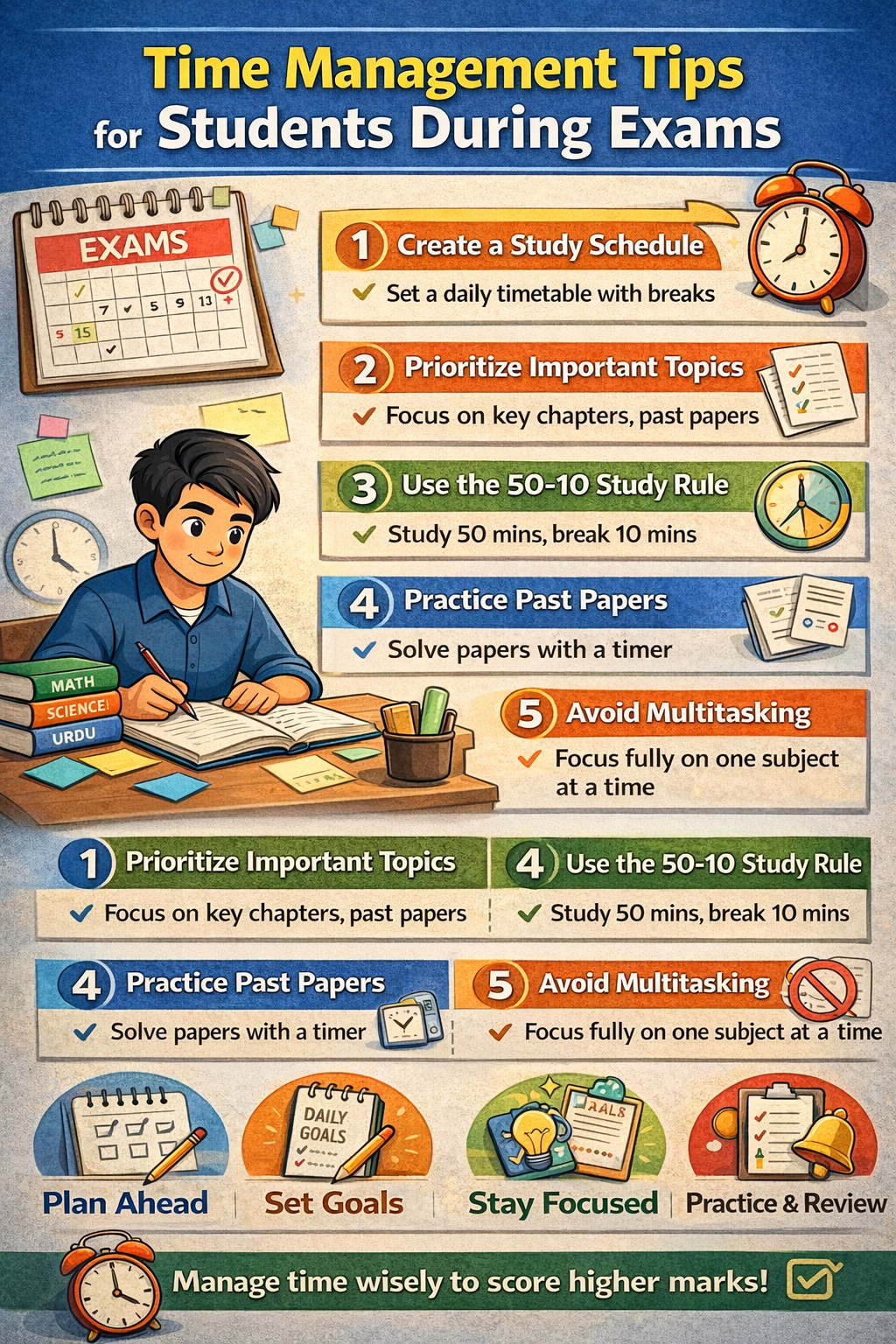
1. Create a Realistic Study Schedule
A timetable gives direction and removes confusion about what to study.
How to make one:
- List all subjects.
- Identify difficult and easy topics.
- Assign more time to weak subjects.
- Include breaks every 45–60 minutes.
- Keep daily revision time.
Avoid making unrealistic schedules like studying 12 hours daily if you’re not used to it.
2. Use the 50-10 Study Rule
This method improves focus and prevents burnout.
- Study for 50 minutes
- Take a 10-minute break
- Repeat the cycle
Short breaks refresh the brain and improve productivity.
3. Prioritize Important Topics First
Not all topics carry equal marks.
Focus on:
- Frequently asked questions
- Past paper topics
- High-weight chapters
- Weak areas
This strategy helps you score maximum marks even with limited time.
4. Avoid Multitasking While Studying
Many students try to:
- Use mobile phones
- Watch videos
- Chat with friends
Multitasking reduces learning efficiency.
Instead:
- Keep phone away
- Study one topic at a time
- Use focus apps if needed
5. Practice Past Papers with Time Limits
Solving papers within time improves speed and confidence.
Steps:
- Set a timer according to exam duration.
- Attempt paper seriously.
- Check mistakes afterward.
- Improve weak areas.
This is one of the best time management strategies for exams.
How to Manage Time During the Actual Exam
Many students lose marks because they don’t manage time inside the exam hall.
Step-by-Step Exam Time Strategy
- Read the paper carefully (5 minutes).
- Start with easy questions first.
- Divide time per question.
- Keep last 10 minutes for revision.
Also Read About: Daily Study Timetable for Matric Students
Never spend too much time on one question.
Sample Exam Time Division Table
| Section | Suggested Time |
|---|---|
| MCQs | 15–20 minutes |
| Short Questions | 35–40 minutes |
| Long Questions | 60–70 minutes |
| Revision | 10 minutes |
This structure helps complete papers on time.
Common Time Management Mistakes Students Make
Avoid these mistakes:
❌ Studying without a plan
❌ Wasting time on social media
❌ Ignoring weak subjects
❌ Last-minute cramming
❌ Sleeping too late before exams
Small mistakes can reduce performance significantly.
Daily Time Management Routine for Exam Days
A balanced routine improves efficiency.
Example Routine:
- Morning: Difficult subjects
- Afternoon: Practice questions
- Evening: Revision
- Night: Light study or memorization
Always include sleep of 7–8 hours.
How to Pass Time Productively Before Exams
Instead of wasting time:
- Revise flashcards
- Read summaries
- Practice MCQs
- Review formulas
- Teach someone else a topic
These quick methods strengthen memory.
Mini Tool: 3-Step Quick Planning Method
If you feel overwhelmed, follow this:
Step 1: Write 3 topics to complete today
Step 2: Assign time blocks
Step 3: Review progress at night
Simple planning works better than complex systems.
Importance of Time Management for Students
Students who manage time properly:
- Feel less stressed
- Have better confidence
- Score higher marks
- Develop discipline for future success
Time management is a life skill, not just an exam skill.
Start small, stay consistent, and trust your preparation. Also, check official board updates regularly and use our free tools and study planners to stay organized.
FAQs
How to manage my time for the exam?
Create a realistic timetable, prioritize difficult subjects, use focused study sessions, and practice past papers with time limits.
What is the best strategy for time management during exams?
The best strategy is planning ahead, studying in focused blocks, and dividing time wisely during the exam paper.
How to manage time as a student?
Set daily goals, avoid distractions, follow a routine, and revise regularly instead of last-minute cramming.
How to pass time in an exam if you finish early?
Use extra time to revise answers, check calculations, correct spelling mistakes, and review skipped questions.
Why is time management important during exams?
It reduces stress, improves performance, ensures syllabus completion, and helps students score higher marks.
Conclusion
Time management during exams is the key difference between average and high-performing students. You don’t need to study all day — you need to study with planning, focus, and smart strategies. Creating a timetable, prioritizing important topics, practicing past papers, and managing time inside the exam hall can dramatically improve your results.